
Manufacturing companies have been outperformers on the bourses in the current year, leading to a rise in their weighting in the benchmark index. Companies in sectors such as FMCG, automobile, pharmaceuticals, metals, cement, and agrochemicals now account for 25.43 per cent of the Nifty 50 index, up 88 basis points from 24.55 per cent at the end of December last year and a record low of 23.1 per cent at the end of CY20. The manufacturing sector is now dominated by FMCG majors such as Hindustan Unilever, ITC, Asian Paints, Nestle, and Britannia, accounting for 45 per cent of the combined market cap of all manufacturing companies in the index.

Investors' wealth has eroded by over Rs 6.15 lakh crore in three days of market decline amid weak global cues and persistent selling by foreign funds. The BSE benchmark Sensex tumbled for the third straight session on Friday to close at 59,306.93, down 677.77 points or 1.13 per cent. In three days, the 30-share index has lost 2,043.33 points or 3.33 per cent.

Equity investors became richer by over Rs 5.77 lakh crore on Tuesday, helped by a rally in the broader market where the BSE benchmark jumped nearly 2 per cent. The BSE Sensex zoomed 934.23 points or 1.81 per cent to settle at 52,532.07. Driven by the rally in equities, the market capitalisation of BSE-listed firms jumped by Rs 5,77,006.83 crore to stand at Rs 2,40,63,930.50 crore. "Absence of fresh selling triggers in the domestic and global economy along with falling commodity prices relieved the heavily discounted equity market to showcase recovery.

Foreign portfolio investors' (FPIs') shareholding in NSE-listed companies fell 51 basis points sequentially to 17.68 per cent in the quarter ended March 31, 2024, according to data compiled by PRIME Database. This is the lowest FPI shareholding since December 2012. From the recent peak of 21.21 per cent at the end of December 2020, FPI shareholding is down 353 basis points.

The rally in mid- and small-cap stocks has spilled over into the IT sector as well. Second and third-tier IT stocks, which historically traded at a discount to the big five IT companies, are now trading at nearly 25 per cent premium to their large-cap peers. The smaller IT companies have a price-to-earnings (P/E) multiple of nearly 38 times against the big five's current P/E multiple of around 31x.

The stock of footwear major Bata India has been the highest gainer among larger listed footwear companies since the start of the month on expectations of a recovery in the value segment, new launches and measures by the new government to boost consumption. The third largest footwear maker by market capitalisation has been trailing its peers over the past few quarters due to the slowdown in the mass segment market which accounts for a significant chunk of its revenues.

Stock exchanges have intensified vigil on Small and Medium Enterprise (SME) listings by mandating more comprehensive financial disclosures and enhanced monitoring of utilisation of issue proceeds from investment bankers, amid rising instances of dubious practices. Bourses - responsible for vetting initial public offering (IPO) documents and granting approvals to SMEs - have tightened norms in recent weeks with further measures planned for new filings to safeguard investor interests, sources said.

Midcap stocks Hero MotoCorp, Zydus Lifesciences, JSW Energy, NHPC, Bharat Heavy Electricals, Bosch, and Samvardhana Motherson are expected to earn upgrades.

Framing the next chapter in Swiggy's journey as a responsible corporate citizen, co-founder and chief executive officer (CEO) Sriharsha Majety unveiled the company's eagerly awaited public listing. Majety, who has largely shunned the spotlight, shared reflections on his entrepreneurial path and the strategic pivots he and his co-founders navigated in building Swiggy. "We started with code aggregation, then pivoted to logistics, and that became Swiggy.

Investor wealth worth over Rs 13.44 lakh crore was wiped off on Thursday as the domestic equity markets tumbled along with global risk assets, after Russia launched military operations against Ukraine. Amid intensifying rout in the global financial markets, the 30-share BSE Sensex plummeted 2,702.15 points or 4.72 per cent to end at 54,529.91. The carnage on Dalal Street eroded investor wealth worth Rs 13,44,488.54 crore, taking the total market capitalisation (m-cap) to Rs 2,42,24,179.79 crore on the BSE.

Ola Electric share price strategy: The meteoric rise of Ola Electric share price has left analysts and investors bewildered. Yet, they suggest investors hold on to the stock as it remains a pure "momentum" play. Since its listing on August 9, the stock has surged 92 per cent (till August 19) over its issue price of Rs 76, taking its market capitalisation to a little over Rs 63,000 crore.

Largecap companies are generally less vulnerable to economic slowdowns than their mid- and smallcap counterparts.

The present government had removed the need for clearance from Dhaka for Pakistani heads of missions while issuing visas, Bangladesh high commissioner to Pakistan Iqbal Hussain told the business community here at the Lahore Chamber of Commerce and Industry on Saturday.

Market capitalisation of BSE-listed companies jumped to an all-time high of over Rs 280 lakh crore on Monday as benchmark indices bounced back after taking a breather in the previous trade. The 30-share BSE benchmark gained 85.88 points or 0.14 per cent to settle at 61,308.91. During the day, it jumped 162.45 points to 61,385.48.

At its current stock price, RIL now has 8.4 per cent weight in the Sensex against Infosys' 8.8 per cent.

Eight of the top-10 most valued firms together lost Rs 2,21,555.61 crore from their market valuation last week in-line with the weak trend in the broader market, with Infosys and HDFC Bank suffering the biggest hit. The 30-share benchmark index, Sensex, lost 1,141.78 points or 1.95 per cent last week. From the top-10 pack, only Reliance Industries and Adani Green Energy emerged as the gainers.

The country's m-cap is now 4.3x India's, whose m-cap grew just 17 per cent to $2.5 trillion in CY20 -- 2.4 per cent of the global m-cap.. Ashley Coutinho reports.

India is likely to see over 100 mature, large-scale profitable or on the path to profitability startups in the next five years, of which 80 have the potential to go for public listing, market research and consultancy firm Redseer said on Tuesday. Redseer Strategy Consultants, in a report on IPOs, said 20 of the mature startups have gone public so far. "India may see over 100 matured, large-scale profitable/path-to-profitability start-ups in the next five years.
In dollar terms, its m-cap rose to $76 billion

The recent sell-off in IT stocks such as Infosys and Tata Consultancy Services (TCS) has resulted in a sharp decline in the IT sector weighting in the Nifty50 index. The sector's weighting in the index has slipped to a five-year low of 12.2 per cent, down from the 17.7 per cent at the end of March 2022. The top IT companies - TCS, Infosys, Wipro, HCL Technologies, and Tech Mahindra - accounted for 13.6 per cent of the index at the end of March this year.

Overall, in the last five straight sessions, the index has lost nearly 1,129 points.

Once declared a dud stock, Suzlon has generated stellar returns for investors thus far this calendar year. On a year-to-date (YTD) basis, Suzlon's share price has doubled investor wealth by soaring 109.35 per cent on the bourses. By comparison, the benchmark BSE Sensex has gained just 11.2 per cent.

Investor wealth on Friday declined over Rs 2.23 lakh crore as markets cracked. The 30-share BSE Sensex slumped 549.49 points or 1.11 per cent to close at 49,034.67. During the day, it plunged 788.37 points to 48,795.79.

Noel Tata -- the half-brother of late Rata Tata -- who takes over as chairman of Tata Trusts, has been with the Tata Group for over four decades, slowly rising through the ranks in the salt-to-software conglomerate. Having functioned mostly under the shadows of his illustrious half-brother, Noel (67) will now have the responsibility of leading the Tata Trusts -- broadly comprising Sir Ratan Tata Trust & Allied Trusts, and Sir Dorabji Tata Trust & Allied Trusts -- that hold a controlling 66 per cent stake in Tata Sons, the holding and promoter firm of Tata Group companies.

Investor wealth grew by Rs 3.41 lakh crore on Tuesday as markets made a dashing comeback after two days of losses. The 30-share BSE Sensex soared 834.02 points or 1.72 per cent to close at 49,398.29. Following the upbeat sentiment, the market capitalisation of BSE-listed companies jumped Rs 341,846.01 crore to Rs 1,96,19,149.34 crore.

Owing to a big rise in the market capitalisation of group companies such as Adani Green Energy and Adani Transmission, the group promoters, the Gautam Adani family, have closed the wealth gap with Mukesh Ambani, the promoter and owner of Reliance Industries Ltd (RIL). Ambani continues to top India's billionaire league table. The Ambani family's net worth was estimated to be Rs 8.06 trillion (around $108 billion) on Tuesday against the Rs 6.87 trillion (around $92 billion) of the Adani family.

At a time when investors are preferring higher-risk investment products like thematic and small-cap mutual fund (MF) schemes, some fund houses are exploring the possibility of going further down the market-capitalisation (m-cap) ladder to unearth newer investment opportunities. HDFC MF had filed papers with the capital markets regulator - the Securities and Exchange Board of India (Sebi) - earlier this year for an active micro-cap scheme. Some more fund houses are keen on launching such schemes, say industry observers.

Investors' wealth tumbled by over Rs 7.35 lakh crore on Friday, with the BSE benchmark Sensex plummeting 1,688 points amid a global selloff triggered by a new coronavirus variant. The 30-share index tumbled 1,687.94 points or 2.87 per cent to close at 57,107.15. During the day, it tanked 1,801.2 points or 3.06 per cent. Tracking the weak trend, the market capitalisation of BSE-listed companies slumped by Rs 7,35,781.63 crore to reach Rs 2,58,31,172.25 crore.

'Though one cannot paint the entire microcap basket with the same brush, investors need to be careful now as to what they're buying.'

'If the period between 1991 and 2014 was about laying the foundations and building the runway, the period from 2014 to 2024 has been about the aircraft taking off.'

Investor wealth on Wednesday tumbled over Rs 3.27 lakh crore as markets witnessed massive selling pressure amid rising coronavirus cases in the country. The BSE benchmark index plunged 871.13 points or 1.74 per cent to close at 49,180.31. During the day, it declined 931.1 points to 49,120.34. Following the weak trend, the market capitalisation of BSE-listed companies tumbled Rs 3,27,967.71 crore to reach Rs 2,02,48,094.19 crore at the close of trade.
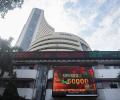
The top 10 valued firms added a total Rs 1,56,317.17 crore to their market valuation last week, helped by across the board rally which catapulted the benchmark index Sensex to the record 60,000 mark for the first time. During the last week, the 30-share BSE benchmark rallied 1,032.58 points or 1.74 per cent. The BSE Sensex made history on Friday by reaching the 60,000-mark for the first time ever. The market capitalisation (mcap) of Reliance Industries zoomed Rs 58,671.55 crore to reach Rs 15,74,052.03 crore. The m-cap of RIL went past Rs 16 lakh crore mark in intra-day trade on Thursday following a rally in its share price.

Infosys on Tuesday became the fourth Indian company to touch a market valuation of $100 billion. The IT services major has joined the league of TCS, Reliance Industries and HDFC Bank for crossing the $100 billion-mark in terms of market capitalisation (m-cap). The milestone was achieved during the morning trade when the scrip was trading at its 52-week high value of Rs 1,755.6 on the BSE, which took the m-cap to Rs 74.77 lakh crore or $100.78 billion.

rediffGURU Ulhas Joshi answers your personal finance and mutual fund queries.

'Had Haji Pir and/or Skardu been taken, the message would have gone out not just to General Asim Munir and his cohort in the Pakistan army but to the Pakistani people that every terrorist incident in India would lead to substantial loss of territory in PoK.'

Investors have become poorer by a massive Rs 19,50,288.05 crore as equity market sell-offs continued for the fifth day in a row on Monday. The BSE Sensex plunged 1,545.67 points or 2.62 per cent to settle at 57,491.51 on Monday, while, the NSE Nifty slumped 468.05 points or 2.66 per cent to settle at 17,149.10. This is the steepest single-day drop for the indices in about two months. Over the last five sessions, the 30-share Sensex has tumbled 3,817.4 points or 6.22 per cent.

Dalal Street investors became richer by Rs 9.68 lakh crore in five days of market rally, where the Sensex breached the historic 73,000-mark for the first time ever to reach a new record peak, taking the market capitalisation of BSE-listed companies to an all-time high of Rs 376 lakh crore. The 30-share BSE Sensex jumped 759.49 points or 1.05 per cent to settle at a new closing high of 73,327.94 on Monday. During the day, it zoomed 833.71 points or 1.14 per cent to reach its all-time peak of 73,402.16.

The 30-share BSE benchmark tanked 535.57 points or 1.13 per cent to close at 46,874.36 on Thursday. It has now lost 2,917.76 points in five days.

Half of India's top-priced stocks have outperformed the benchmark indices this year. On a year-to-date basis (YTD), the Sensex has gained 3.8 per cent and the Nifty50 3.4 per cent. The stocks which have outperformed the indices include 3M India, Nestle India, MRF, Shree Cement and Bosch while those who have underperformed the benchmarks include Page Industries (-10.4 per cent), Procter & Gamble (-4 per cent), Honeywell Automation (-0.9) and Lakshmi Machine Works, which gained 1.3 per cent.
